Getting Into Those Whole Grains
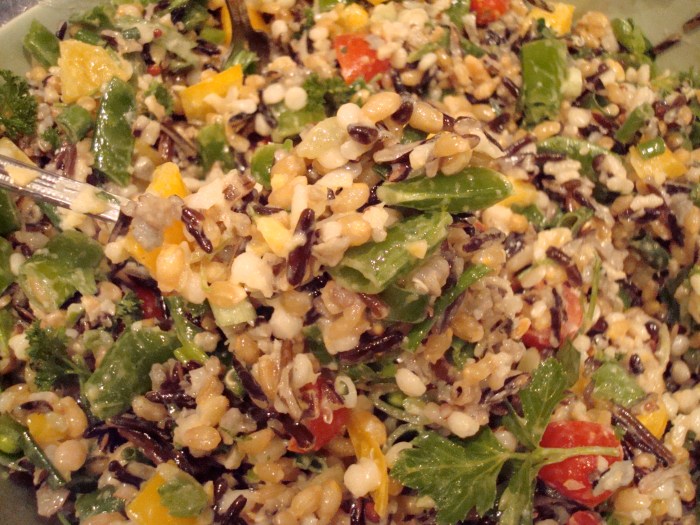
Three Grain Salad Primavera with Lemon Vinaigrette
This is a hearty, nutty, soul-satisfying salad from my sister-in-law, Julia. She picked it up while attending a holistic culinary school in San Francisco. The best part: you can use up those remainders of random grains stashed in the back of the cupboard. I used soft white wheatberries from Stalford Farm here in Oregon (the same source of my locally-grown chickpeas), black wild rice and an Israeli couscous/quinoa blend. This is a recipe that’s hard to screw up, thankfully. I also didn’t have flax seed oil so just doubled the olive oil in the dressing. Dan threw in some grape tomatoes (which he purchased against my will. I’m trying to abstain from eating tomatoes outside the local season. Winter tomatoes or those from Mexico just don’t compare.)
Here’s the recipe for you to enjoy (feel free to half the portion, but it keeps well in the fridge for the week):
Three Grain Salad Primavera with Lemon Vinaigrette
(serves 16)
Grain salad options (you will need 1 cup of three of these grains):
spelt
quinoa
wheatberries
wild rice
bulglur
barley
Israeli couscous
Choose three of these or other favorite grains — you will want to end up with 7 cups
cooked product total
Vegetables for salad:
1/2 red pepper, chopped
1/2 yellow pepper, chopped
1/2 orange pepper, chopped (NOTE- i used 3 whole peppers- just eyeball it)
1/2 pound green beans or snow peas, slivered
1 small red onion, chopped
1/2 bunch scallions, chopped
1/2 bunch italian parsley, chopped
1/2 bunch fresh mint, finely chopped
Dressing ingredients:
1/2 cup lemon juice
4 teasponns dijon mustard
2 garlic cloves, minced
1/2 teaspoon sea salt, or to taste
1/2 cup olive oil
1/2 cup other vegetable oil like flax seed oil or safflower
2 tbsp warm water
2 teaspoons lemon zest, finely chopped
Choose three grains and cook 1 cup of each separately. Set them aside to cool while
preparing the vegetables and the dressing. As the vegetables and herb s are chopped, put
them into a large mixing bowl.
Combine all of the dressing ingredients except water and lemon zest, and whisk together
or put in a blender or small food processor. Cover and blend. Add warm water and blend
until smooth while the machine is running. Taste, adjust as needed, and then add the
lemon zest. (Dressing will keep in fridge for up to 2 weeks).
Measure out 7 cups of the combination of cooled grains. Add to the vegetables in the
mixing bowl and toss to combine. Add 1/2 cup of the dressing and toss to coat the grains
and vegetables lightly. Taste and adjust if more dressing is needed. Serve chilled or
at room temperature.
A Bar That Could Make You Love Corvallis

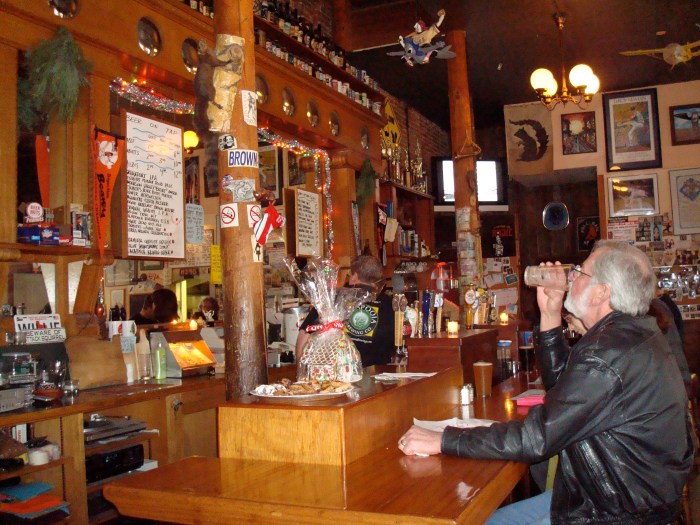
Bluegrass band playing at Squirrel's Tavern tonight.
I’m embarrassed to say we’ve only been to the best bar in Corvallis twice. Hopefully we will make Squirrel’s Tavern a more frequent habit. They offer a tremendous selection of local microbrews on draft and grill up some luscious burgers. Someday we’ll try the Squirrel Burger (topped with a fried egg and ham). Or gross?
The bar was jam-packed tonight with a festive crowd for a fundraiser for the local wildlife rescue center. The local Oregon Trail Brewery donated kegs of its nut brown ale; all proceeds went to the animal shelter. We munched on free roasted hazelnuts and listened to a bluegrass band playing in the eves.
Great burgers and brews in a vintage wood-paneled pub. My father-in-law about died and went to heaven there.
“American Girl”: The Other Obama

Flickr Creative Commons/ http://www.flickr.com/photos/mikebaird/2805195898/sizes/l/
It was her husband’s day, but my eyes kept drifting towards the stately Michelle Obama, watching the televised inauguration festivities this week.
Check out Baltimore native Ta-Nehisi Coates’ Atlantic piece on the “radical normalcy” of Michelle Obama, how she disrupts all stereotypes of the angry black woman. “The first time I saw Michelle Obama in the flesh, I almost took her for white,” Coates writes in the jarring opening of his piece. In a related video segment, Coates tells his father he’s almost more confident about her ability to be first lady than Obama’s as president.
And read this profile of her by my friend Nia-Malika Henderson, who is hot on the first family beat.
“Michelle disrupts a lot of the racial and gender stereotypes that people have about black women, that they are single, unhappy, angry, not very literate, or hustlers, hypersexual, inappropriate, mammy, seductress, I could go on, servant, all of those stereotypes are all out there,” Guy-Sheftall. “I think the dominant culture doesn’t know what to do with Michelle, so they put her in a frame with which they are familiar. The angry black woman stereotype is predictable, we know that one, then when she was not really conforming to that story, then it shifted to her fashion.”
|
|||
A Chicken in Every Pot


I plan to roast more whole chickens this year. They are economical, yield moist meat and at least three meals for the week. I roasted one Sunday night, slathering it first with a favorite salt rub we also used on our Thanksgiving turkey. I’m still figuring out the optimal temperature and time to cook the bird at in our convection oven. Any suggestions?
Then tonight, I briefly sauteed the shredded chicken with onions, a pasilla pepper and chile powder, baking it or tortillas with sauce and cheese for enchiladas.
I also boiled the carcass for soup stock but accidentally left the pot out overnight. So I chucked it. How long is it safe to leave the fresh chicken broth out?
Will you find yourselves cooking more whole chickens this year? It could be a 2009 food trend.
Clemenza’s: Some of the Best Italian Food Around

Rigatoni Clemenza ($10 for a heaping serving)
After last week’s disappointing trip to local-chain Pastini Pastaria (overcooked pasta, ridiculous waits), we were thrilled to finally make it to Clemenza’s Italian American Cafe in neighboring Albany. Hands-down it has to be the best Italian place in this area, especially when you consider the quantity and quality you get for the price.
I had the Rigatoni Clemenza, with a unique spicy-sweet tomato sauce fortified with with pureed broccoli and shreds of the stalk, cubes of dried salami, a dusting of Italian bacon and baked cheese. Pictured is a more than ample “medium” portion. For just dollars more, Clemenza’s lets the big eaters order a larger plate of the entree. Dan took that route, happily feasting on baked spaghetti with a rich three meat (beef, turkey and pork) sauce. Clemenza’s is his Platonic ideal of a restaurant: homestyle, unpretentious pastas and simple sauces that speak for themselves. With two small cups of the house red, the bill came to only $26. Move over, Mamma Zu.
Restaurants like Clemenza are slowly revitalizing blue-collar downtown Albany, which unjustly plays step-sister to tonier Corvallis, though both small cities have similar sized-populations. Leading the progress are restauranteurs Matt and Janel Bennett. They’ve run the more upscale Sybaris in Albany for several years. That’s where we had that magical mushroom dinner this fall. Then the Bennetts opened Clemenza’s just down the main street in June. Chef Matt Bennett is a rising culinary star here, especially since he cooked at the Beard House in NYC.
Albany could use a third spot with his magic touch. Let’s hope a rumor suggesting that was in the cards comes true!
Portland: Even Whiter Than Salt Lake City

White bikers in Portland/Flickr Creative Commons/By taisau https://baltimoregon.wordpress.com/wp-admin/post-new.php)
On this eve of Martin Luther King Jr. Day and, more importantly, Obama’s ground-breaking inauguration, I was saddened (but not surprised) to read Portland remains the whitest city center in the nation.
College-educated Americans are overwhelmingly white, and those who migrate to Portland are disproportionately so — the “beer, bikes and Birkenstock” crowd, in the words of Portland economist Joe Cortright.
Portland-area employers competing for top talent have a hard time retaining African American hires, who often can’t bear the social and cultural isolation of a metro area that is less than 3 percent black.
First visiting Oregon in May to look for housing, I was shocked to read the front-page New York Times story on the state’s virulently racist history. The state officially barred blacks from establishing residency here until the 1920s. I hope to write more about this tension in an otherwise politically liberal state with this torrid racial past many progressives still don’t want to confront. The experiences of black and other minority college students in Oregon are especially poignant. There was a probing discussion and documentary on “Being Black” at Oregon State shown on campus here last week.
It’s a Bird, It’s a Plane, It’s Super Yoga!


One benefit of being in between jobs here: I have the time to sit-in on unusual lectures and workshops. Like this acro-yoga class I just started at the Cedar and Fir Yoga Studio here.
I had vaguely heard of acro-yoga before and knew I had to try it when I saw the flyer. It’s a true out of body experience, the closest you’ll get to weightlessness or flying. I only wish my partner would do this form of yoga with me. It has me getting rather intimate with strangers instead. His loss!
Some of the positions remind me of what we called “Superman” when we were kids. Our dad would put his feet on our stomaches, raise his legs and lift us flying into the air. I used to do it to my sister Carolyn too. There may have been an accident or two.
These inverted poses really release pressure from your spine and act as traction for your neck. I encourage everyone to try acro-yoga if it’s offered in your area. Most cities should. Let me know about your experiences if you’ve tried it.
Van Jones: “Greening the Ghetto?”
Van Jones/Flickr Creative Commons/By mari-posa http://www.flickr.com/photos/mari-posa/266459153/
I turned straight to Elizabeth Kolbert’s profile of Van Jones, the Oakland-based green jobs advocate who says tackling climate change can reduce urban poverty, in this week’s New Yorker. There’s no doubt that Jones is an incredibly persuasive speaker and one of the first to make the predominately white and affluent environmental movement relevant to underemployed young black males.
“I think Van Jones is a big part of the future of environmentalism,” Gus Speth, the dean of Yale’s School of Forestry and Environmental Studies and a co-founder of the Natural Resources Defense Council, told me. “He, more than anyone else, is bringing together a concern about the environment and a concern about social justice. And, if I had just one thing to say, it is that we in the environmental movement cannot fail Van Jones.”
But the jury is still out. Unfortunately those jobs in solar and wind haven’t materialized yet, and some economists suggest that addressing climate change (through a carbon tax on fossil fuels) could in fact disproportionally hurt poor families. Congress approved a Clean Energy Jobs Bill, at Jones’ behest, but the $125 million for such job training has yet to be appropriated.
And will Obama’s economic stimulus plan promote green jobs or primarily traditional projects, such as highway expansion?
I wrote briefly about Van Jones on community colleges/green jobs here:
http://chronicle.com/daily/2008/10/5211n.htm
Tuesday, October 21, 2008
Community Colleges Are Key to ‘Green’ Jobs,
Speaker Says
By LAURA MCCANDLISH
Austin, Tex.
Straddling the divide between government and industry, community colleges play a pivotal role in pushing our
fossil-fuel-dependent economy toward a reliance on renewable energy, the environmental activist Van Jones
said in an opening address to the National Council for Workforce Education conference here on Sunday.
“You are the fulcrum on which this whole transition is going to be made,” Mr. Jones told a throng of
community-college educators, who broke into applause.
Community colleges are key to Mr. Jones’s sustainability priorities because the new jobs in solar- and
wind-power installation and green construction will require more than a high-school education but less than a
four-year degree, he said.
A community organizer in Oakland, Calif., Mr. Jones advocates for millions of new environmental jobs to
both combat global warming and lift underemployed people out of poverty. He is a ubiquitous presence on the
sustainability circuit, particularly since his book The Green Collar Economy: How One Solution Can Fix Our
Two Biggest Problems (HarperOne) hit the shelves this month. He is also a scheduled keynote speaker at the
Association for the Advancement of Sustainability in Higher Education conference, in November.
A Glitch in the System
Solar-panel installation is a low-skilled “green collar” job that has the most immediate demand for workers,
Mr. Jones said. In Marin County, California, he said, a lack of manpower means residents wait months just to
have their photovoltaic cells hooked up. The cells convert solar energy into electricity.
“Somehow there’s a glitch in the system where we can’t commit the people who most need work with the
work that needs to be done,” said Mr. Jones, who is a Yale Law School graduate and senior fellow with the
Center for American Progress. That’s where the community colleges come in.
Founded in 2005, his “Green Jobs, Not Jails” movement is working with Laney College, in Oakland, Calif.,
this fall to start training 40 at-risk adults in solar installation and green construction.
Manufacturing the thousands of machine parts that make up a wind turbine could likewise help rehabilitate
the chronically depressed economy in Michigan, which has the nation’s highest unemployment rate, having
shed nearly 500,000 jobs since 2000, according to the State Legislature.
Print: Community Colleges Are Key to ‘Green’ Jobs, Speakers Say – Chron… http://chronicle.com/cgi-bin/printable.cgi?article=http://chronicle.com/dai…
1 of 2 10/22/2008 11:10 AM
“You could put Detroit back to work not making SUV’s to destroy the world but wind turbines to save the
world,” Mr. Jones said, drawing an enthusiastic response from the numerous conference attendees from
Michigan’s community colleges.
But until industry demonstrates more demand for green workers, many community colleges will be hard
pressed to add new programs. Even in sunny Florida, the solar-installation jobs have not yet materialized, Jeff
J. Stevenson, the chief economic-development officer at Gulf Coast Community College, in Panama City,
said after Mr. Jones’s speech. That’s because solar technology is still much costlier than coal and unreliable in
indirect sunlight, Mr. Stevenson said.
A similar situation faces Macomb Community College, outside Detroit. The college would eagerly expand its
program in hydrogen fuel-cell technology. But the Big Three automakers have not yet embraced the
technology as a commercially viable alternative energy source, said James O. Sawyer, vice provost of
Macomb’s career programs.
Welfare, the Streets, or Prison
Community colleges must also first ensure that students succeed in developmental mathematics and literacy
programs so more can advance to course work and jobs in those emerging fields, said Kay M. McClenney,
director of the Community College Survey of Student Engagement at the University of Texas at Austin.
“If we don’t do developmental education, both unapologetically and exceedingly well, those students are not
going to go on to green-collar jobs or anything other than welfare, the streets, or prison,” she said.
Mr. Jones advised his audience to develop green-collar sectors through strong partnerships with employers,
particularly the utility companies, and legislators.
“The worst thing we can do is overtrain, passing out a lot of certificates but no green jobs,” he said. “You
don’t want to train 1,000 people for four jobs.”
Laura McCandlish, a former reporter at The Sun, in Baltimore, who now lives in Corvallis, Ore., is an
associate fellow in a program sponsored by the Hechinger Institute on Education and the Media to support
in-depth coverage of community colleges.
Copyright © 2008 by The Chronicle of Higher Education
Subscribe | About The Chronicle | Contact us | Terms of use | Privacy policy | Help
Print: Community Colleges Are Key to ‘Green’ Jobs, Speakers Say – Chron… http://chronicle.com/cgi-bin/printable.cgi?article=http://chronicle.com/dai…
2 of 2 10/22/2008 11:10 AM
Farro Pharaoh, I Might Just Let You Go

Zuppa Di Farro
 This soup made a hearty winter dinner, but in cooking with farro for the first time, I was disappointed. Why did I buy the imported Italian grain that was virtually indistinguishable from the soft white wheat berries I already had at home. Spelt is also very similar to farro. So if you can’t find it, don’t sweat.
Barley is also a suitable substitute.
The Zuppa Di Farro recipe comes from Portland chef Ivy Manning’s beautiful The Farm To Table Cookbook. I had the pleasure of hearing Manning speak on a food-writing panel at Wordstock.
Any positive or negative experiences cooking with farro to report? Dan said he preferred a pasta=laden minestrone and that the cauliflower overwhelmed the dish. It’s a tangy, hearty soup that’s greatly enhanced with freshly grated Parmesan Reggiano.
Here’s the recipe:
Zuppa Di Farro/ 8 servings
2 cups dried cannellini beans (I substituted canned white beans and added them near the end)
10 cups cold water
1 ham bone (optional)
1 bay leaf
3 garlic cloves, peeled
2 teaspoons salt
2 tablespoons olive oil
1 slice pancetta or bacon, chopped
1 1/2 cups chopped onion
1 large carrot, peeled and finely diced
1 small parsnip, peeled and chopped
2 celery stalks, chopped
2 teaspoons chopped fresh sage, or 1 teaspoon dried sage
1/2 cup dry white wine
1 cup (14 ounces) diced tomatoes in puree
1 cup farro
1 cup 1 1/2-inch cauliflower florets
1/2 bunch (4 ounces) Lacinato kale (I substituted collard greens)
One 4-inch sprig rosemary
Freshly ground black pepper
Grated parmesan chese, for garnish
1. Pick through the cannellini beans and rinse well. Put the beans in a large bowl, add enough cold water to cover, and soak for 8 hours or overnight. Drain the beans and transfer them to a large soup pot. Add the water, ham bone, bay leaf, garlic, and salt. Bring to a boil, reduce the heat to maintain a simmer, and cook until the beans still have a little bite, about 30 minutes.
2. Heat a large saute panover medium-high heat. Add the oil and pancetta and cook until the pancetta begins to brown, about 5 minutes. Add the onion, carrot, parsnip, celery, and sage. Cook, stirring frequently, until the onion becomes translucent, about 8 minutes. Deglaze the pan with the wine, scraping to loosen any browned bits. Pour the mixture itno the beans.
3. Add the tomatoes, farro, and cauliflower to the beans and simmer gently until the beans and the farro are tender, about 1 hours.
4. Tear the sturdy ribs and stems away from the kale leaves and discard. Tear the kale into bite-size pieces; add them to the soup and cook for 15 minutes. Add the rosemary to the soup and stir. Steep for 1 minute, then remove the sprig or the flavor will overwhelm the soup. Season with salt and pepper and serve, passing the Parmesan separately. when you store the leftovers, the farro and beans will absorb most of the liquid. Add stock or water when you reheat.
Oregon’s Olive Garden
Why do college undergraduates flock to chain-style restaurants that are no cheaper than the independent joints more in walking distance from their campuses?
We made the mistake of going to Pastini Pastaria, an Oregon-only Italian chain, on Friday night, when it was flooded with Oregon State students just back from winter break. It’s family-owned still and only recently expanded from the Portland area to Bend and Corvallis, but is starting to take on that generic Olive Garden feel.
We did see Craig Robinson’s wife and two children sit down to dinner there as we were on our way out. It’s the place to be seen. But we like our pasta at home better.
 BaltimOregon to Maine