Berries and Curd
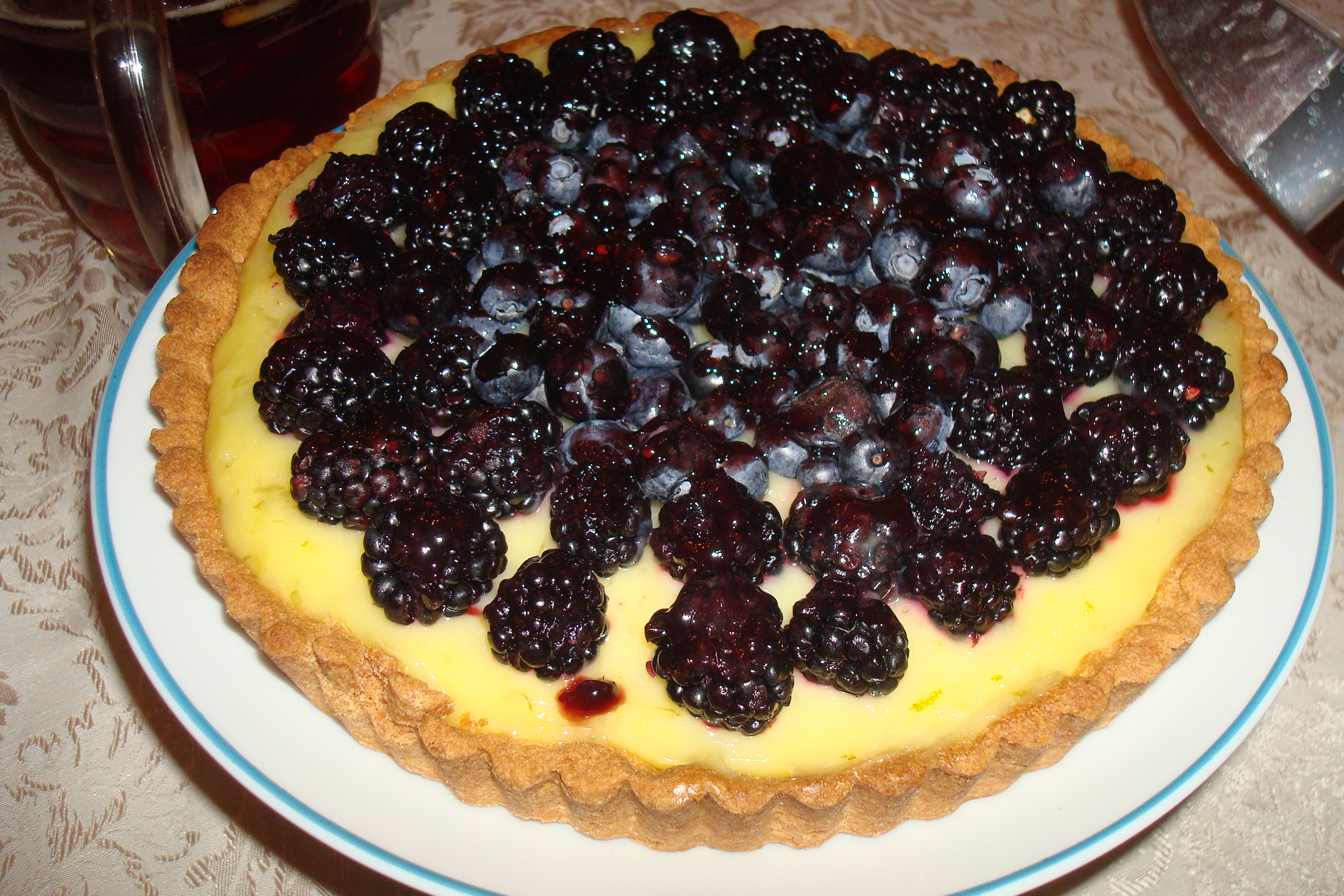
Bon Appetit's Lime Tart with Blackberries and Blueberries.

Ivy Manning's strawberry shortcake with lemon curd cream.
Okay, okay, I finally posted something pretty and tasty for those of you made squeamish by my last blog post. Berries and tart citrus curds (tangy egg yolk puddings) should be less controversial. Well, not curd perhaps. For a shortcut with the above strawberry shortcake dessert, I might recommend buying some store-bought lemon curd. Instead, I stood over a hot stove (in last week’s heat wave, which even swept northernmost Maine) for 30 minutes, constantly whisking the thickening curd slowly heating in a bowl over a pot of boiling water. But stirring that zesty curd into freshly-whipped whipped cream made for a memorable, albeit rich, shortcake. The citrus in the cream and orange zest in the homemade biscuits (I would add chopped crystallized ginger next time, too) complimented the fragrant local Maine strawberries.

The berries are ripe at the Small Farmers' Project site in Eugene.
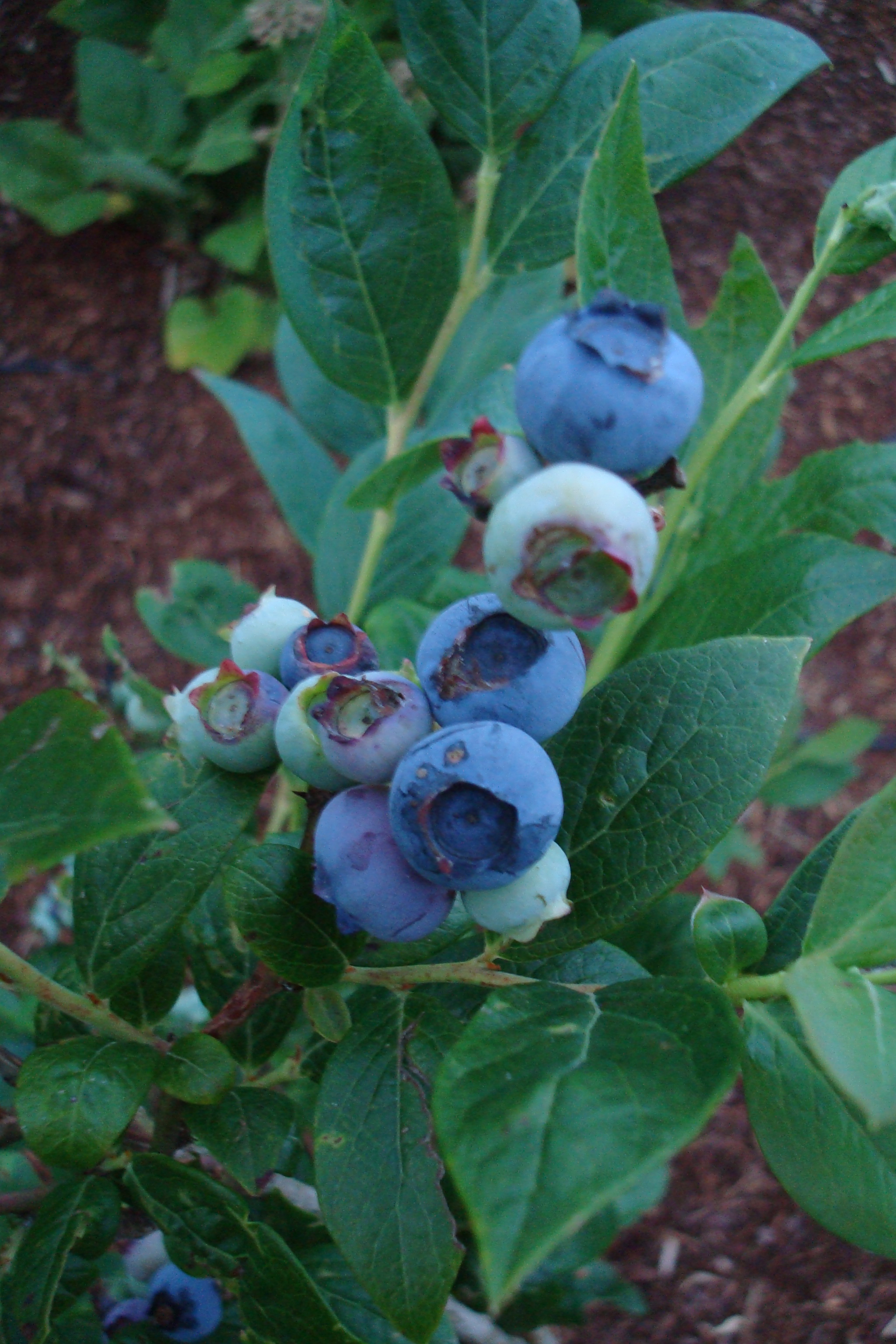
It was sad to leave my blueberries, just now ripening on the cane.
Then just two days later, curd turned up again in a berry dessert tonight at dear reader Judy’s house. She made a magnificent lime curd tart with blackberries and blueberries that looked just like the picture that ran with the recipe in Bon Appetit! With no whipped cream, this fruit tart was a considerably lighter dessert, the perfect conclusion to a barbecue on a warm summer night. Best of all, the latter curd takes less time to make, requiring a mere six minutes of whisking instead of 30. This one calls for gauging the curd temperature with an instant-read thermometer, but both curiously instruct you to press plastic wrap onto the surface of the curd while it cools? Does that just ensure it has a smoother texture? That’s one recommendation I ignored. Here’s a good step-by-step guide to making curd from Bon Appetit. I’ll have to ask Portland cookbook author Ivy Manning why the process she outlined in The Farm to Table Cookbook took so much longer.
Speaking of berries, check out my recent radio piece on rare black cap raspberries, which a group of Latino farmers is reintroducing in the Northwest. I’m sorry I didn’t have a chance to make black raspberry ice cream before we ran out of town. Let’s hope there’s an even larger crop for us to bake and can with next year!
Rabbit Kidney: Like Faintly Urine-Flavored Encased Pate

There's a reason Julia Sunkler sells this organ meat as pet food.

Kidney Yakitori: Looks a little too good to be true. At least the dog loved it.
Let’s just say this enthusiastic “nose to tail” eater has hit her wall. I have reservations, Anthony Bourdain. Andrew Zimmern, you’re too bizarre for me. Fergus Henderson, I can’t quite swallow the whole beast.
Tongue is no problem, whether from a cow, lamb or duck. Liver, cheek, jowl and belly I love. But kidney, at least rabbit kidney, I now know I do not. It’s one piece of offal that was pretty awful. I won’t be eager to try any animal’s kidney (lamb is used for steak and kidney pie), faintly urine-flavored and -scented as it is, again.
Why did I try it? Well, I got into rabbit for a recent article and perhaps the onslaught of criticism I received emboldened me to try some more rogue fare. I sauteed up some rabbit liver, which surprisingly tasted just like that of a chicken’s and made a delicious pate. Then I saw an episode of Treme, where the feisty but reckless chef Janette plates up rabbit kidney skewers and lamb neck when a Who’s Who of NYC chefs (David Chang, Eric Ripert) come to dine in her beleaguered post-Katrina New Orleans restaurant. And I saw Julia Sunkler had kidneys at her My Pharm stand, but in a big bag packaged for pet food. I asked her to set a pound aside for me next time she did slaughtering. It’s all about making the most of the animal.

A sweet soy marinade wasn't enough to mask the faint urine flavor. Not that I know what urine takes like.
But the dogs can have ’em. James Joyce had it right, describing his protagonist’s dietary habits in Ulysses: “Leopold Bloom ate with relish the inner organs of beasts and fowls. He liked thick giblet soup, nutty gizzards, a stuffed roast heart, liver slices fried with crust crumbs, fried hencod’s roes. Most of all he liked grilled mutton kidneys which gave to his palate a fine tang of faintly scented urine.” Kidneys are just pretty gross. Even the soy tamari-honey-sesame oil-garlic-ginger marinade didn’t do much for their off-taste and mushy, gooey consistency. Perhaps it’s better chopped up in a stuffed than roasted whole? You wonder how many toxins you pick up with waste eliminating organs such as the liver, pancreas and kidneys, anyway. Still, when you think about it, kidneys are less gross than intestines (chitlins, tripe, and more commonly, sausage casings) that we seem to consume with relish. After all, urine is sterile. So check it off my list. Now onto chicken heart?

Rabbit liver virgin no more.

Chopped rabbit liver.
Trashed Strawberries Are Our Treasure

Salvaged berries from the Boones Ferry Berry Farm discards at the end of the Corvallis Farmers' Market Saturday.
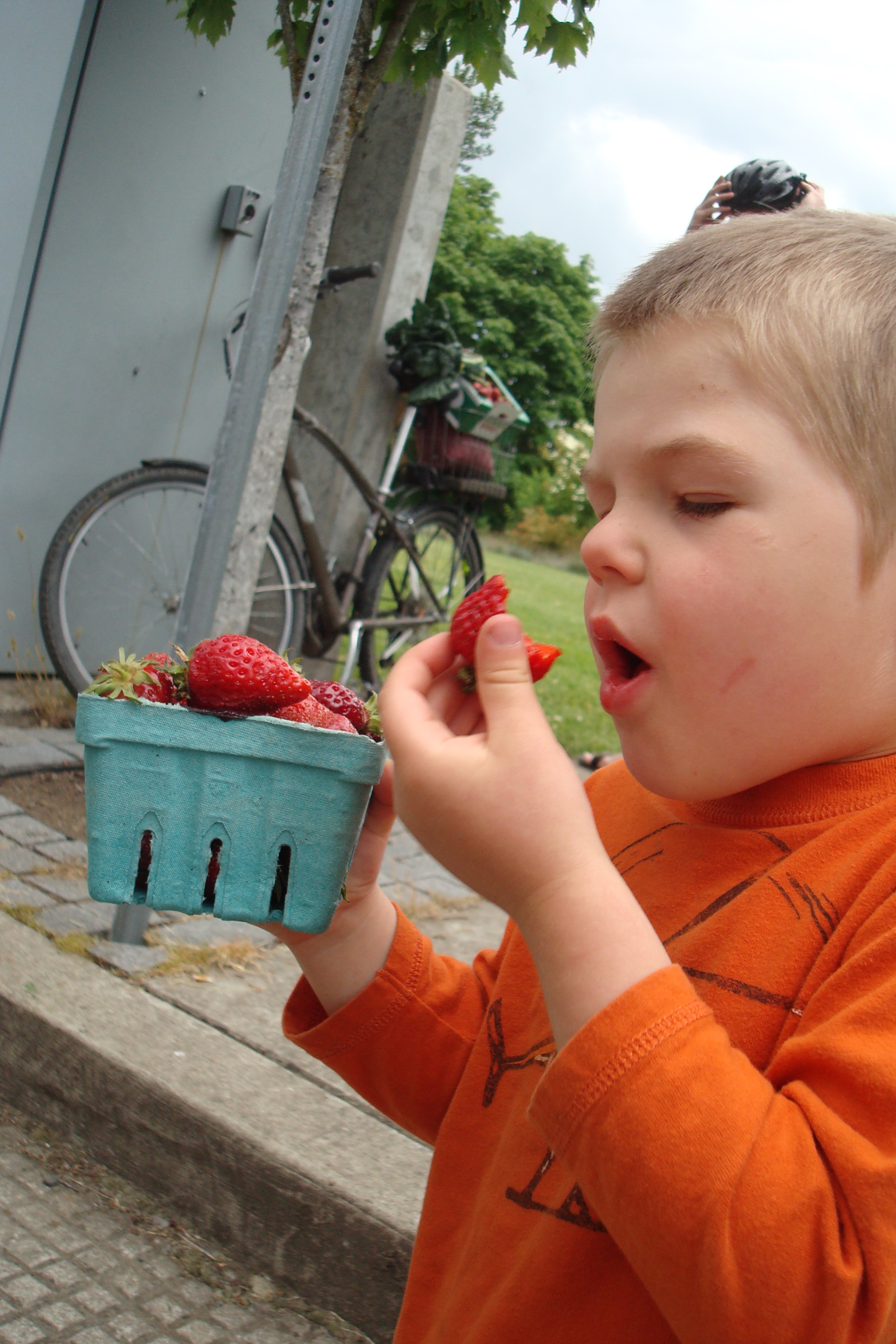
From the mouths of babes: Little George digs into the ones at the GTF stand.
I’m not shy. I have no trouble engaging complete strangers in conversation. Maybe that’s why I interview people and entertain in the front of the classroom for a living.
But still I felt awkward going from stand to stand at the farmers’ market Saturday, asking for donations for the cooking and canning classes EMO’s Interfaith Food and Farms program runs to help folks stretch their tight budgets and learn to make delicious meals with food bank staples.
Then I happened to ask Boones Ferry Berry Farm (near Woodburn) if they had any mushed or overripe berries we could have to cook up into jam. They gave me their “trash” bag, chock fill of syrupy, slightly squishy berries that smelled and looked delish, though were perhaps not quite pretty enough for discriminating consumers. But no one would know the difference when they cooked down into jam.
Fellow master food preservers (and dear friend) Rebecka now heads this cooking class, working closely with Jamming for the Hungry’s Sara Power (who was also in our Master Food Preserver Program). Chef Intaba previously ran these classes when I first moved to Corvallis. These are my girls! That’s where I met Norma, my good friend from Texcoco, Mex., and the mother of three adorable children: Jerry, Michele and baby Dennis.
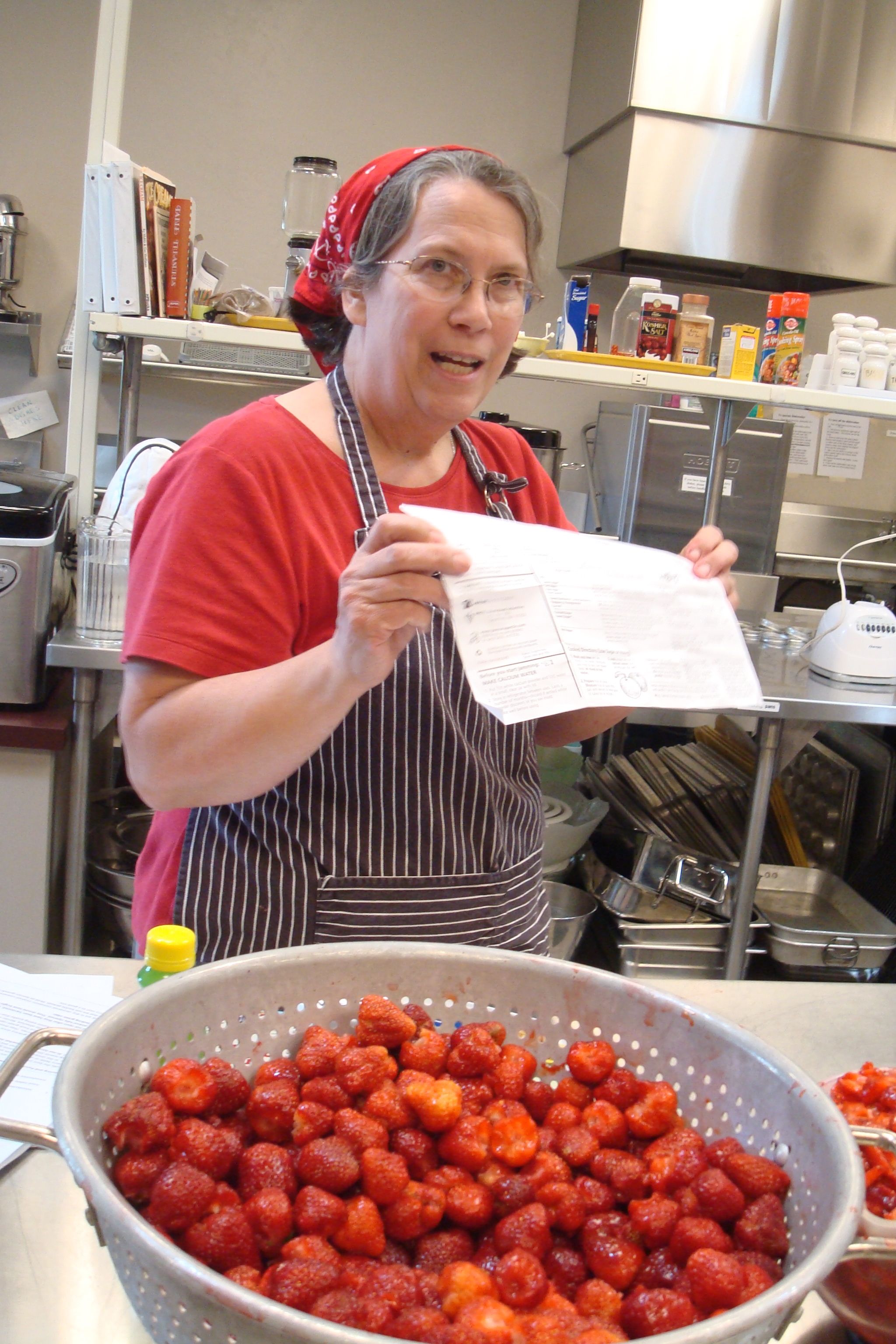

Jerry patiently waits to make jam.
We made low-sugar strawberry jam (and took jars home), strawberry smoothies with yogurt and silken tofu (a food bank staple that often befuddles folks) and a fresh strawberry vinegar for a vinaigrette I helped demonstrate. See the recipe below. I also mixed the vinegar with seltzer for a bracingly tart drink that might be good with simple syrup. Like those Asian drinking vinegars popular at Pok-Pok or old-fashioned shrub drinks. But buyer beware (of stomach ulcers apparently) with the “vinegar cure.”
Also, if your jam is starting to foam if you cook it, we learned that adding a pat of butter helps, and may keep the jam from turning gray. I still might go strawberry picking next weekend, perhaps at nearby Greengable Flower Farm, where they are $1 a pound.
Strawberry Vinegar
Yield: Makes About 2 cups
Active Time 15 minutes
Total time: 1 1/4 hours
Ingredients:
1 pound strawberries, trimmed (3 cups)
2 cups white balsamic vinegar (or apple cider, rice wine vinegar or white wine vinegar…anything but dark balsamic or plain distilled white vinegar)
Pulse berries in a food processor until finely chopped and very juicy. Transfer to a bowl and add vinegar. Strain through a fine-mesh sieve into a jar, discarding solids (don’t strain if you prefer a thicker, pulpy dressing). Keeps in the fridge covered and chilled for a week.
Adapted from Gourmet Magazine
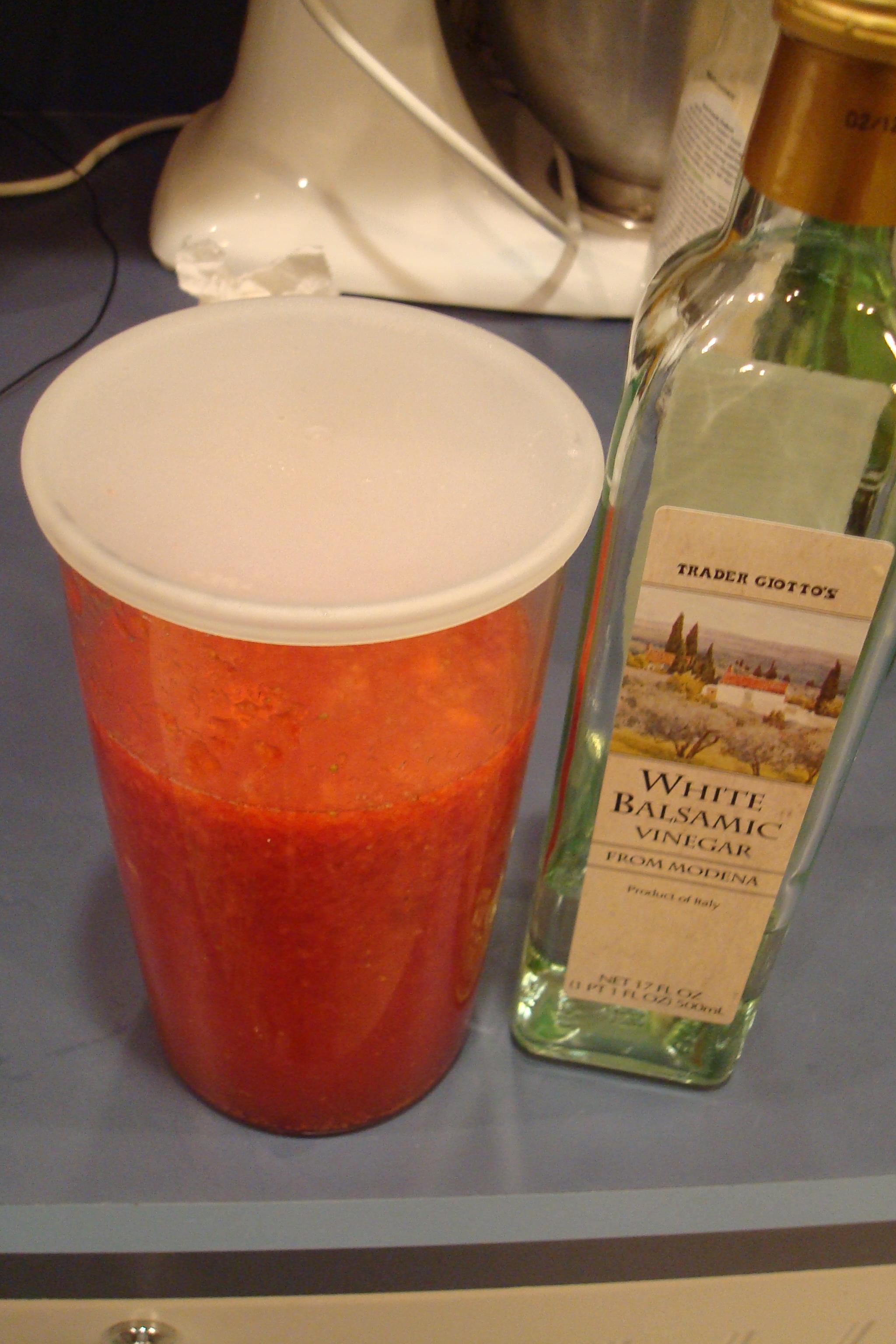 Strawberry Vinaigrette for Mixed Greens Salad
Ingredients:
1 cup olive oil
1/3 to 1/2 cup strawberry vinegar (see recipe above)
1 tablespoon chopped fresh tarragon or 1/4 teaspoon dried
1/4 cup minced onion or shallot
A drizzle of honey to sweeten it up
salt and pepper to taste
Blend ingredients together in a blender, or just shake in a covered jar or beat until mixed and smooth.
Yield: About 1 3/4 cups
*Note: Traditional vinaigrettes have a ratio of 3 parts oil (or other fat, such as warm bacon fat) to one parts vinegar (or other acid, such as citrus juice)
Food Carts Galore

Eugene's new pod in Kesey Square downtown.
Hopefully this fair-weather, intermittent blogging will become more regular again, now that my spring classes have come to an end. Plus, after one of the rainiest June’s yet, it’s finally sunny in Oregon, so I have no excuse not to write about the bounty finally revealing itself in our gardens and farms. Now we have the al fresco dining scene to look forward to, too, and what defines outdoor eating more than mobile food carts?
Portland is world-renown for its ubiquitous carts and Eugene is trying to grow its base of them. Even in Salem and Bend have food carts. But restrictive regulations means Corvallis has next to none, apart from those who vend at our two weekly farmers’ markets. But folks, including a local crepe stand, are hoping to change that. I plan to follow the issue for KLCC.
There in Eugene today for a news meeting, I ventured over to the new pod for lunch. My indulgent Cuban sandwich (with braised local pork belly) from The Nosh Pit lived up to its reputation. For you stoners out there, on late nights the cart even plans to serve a burger on a glazed cruller from the new Voodoo Donuts just ’round the corner. Dropping by Voodoo everytime I’m at KLCC could become a bad habit I start justifying out of love for my husband. The Neapolitan one I had today (old-fashioned chocolate cake doughnut topped with strawberry sugar and marshmallows) could become a new favorite.
Speaking of fatty food cart fare, look no further than to the SE Hawthorne pod in Portland. I had wanted to try Potato Champion ever since glimpsing on a chalkboard list of favorite spots at Naomi Pomeroy’s Beat. But I was underwhelmed. Maybe I didn’t order right, getting the PB&J (Thai peanut and raspberry sauce), which sounds gross as I retype it now. Next time I’ll try the poutine or a truffled or anchioved sauce. Then for dessert there’s the neighboring Whiffie’s fried hand pie cart, the winner of the Willamette Week’s Eat Mobile fest this year. I prefer my fat calories for in the form of fries. But the savory-sweet Hawaiian ham and cheese was a nice savory-sweet compromise.
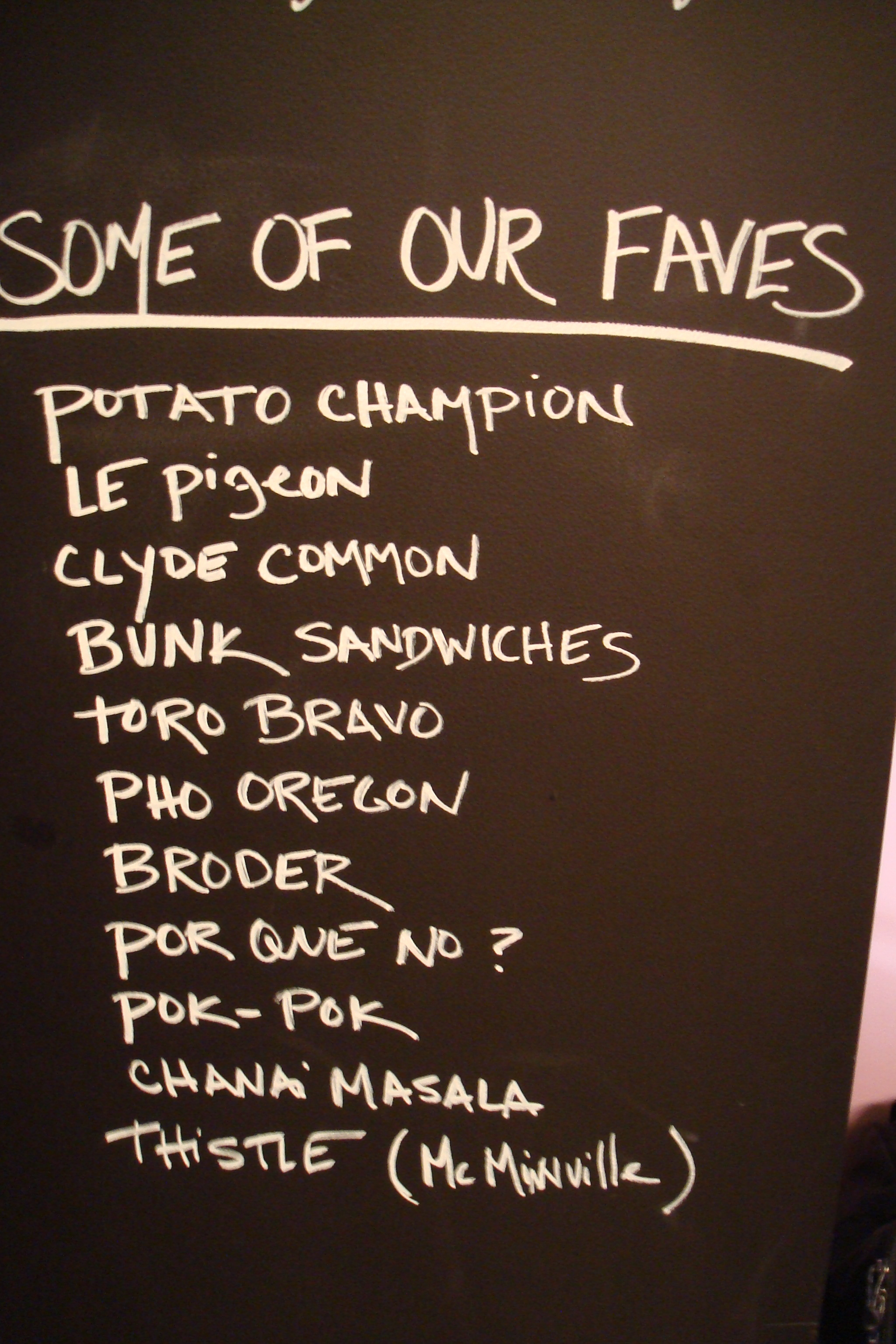
Beast's favorite spots.

Fried food rules here: The famous Potato Champion cart in Portland's SE Hawthorne pod.

Don't forge the fried hand pies at neighboring Whiffie's.
Wild, Wild Strawberries

Tiny wild strawberries foraged in a grassy meadow at Lumos Winery in Philomath/Wren.
The strawberries are just starting to ripen and will hopefully come on in full force once these lingering gray rainy days in Corvallis stop. Though now that I’m writing this from swampy, 90 degree North Carolina this weekend, I appreciate the crisp and refreshingly cool Northwest.
Many are the strawberry recipes I plan to plow into when I return. I especially anticipate roasting over-ripe berries (I remember Ivy Manning some oven-roasted strawberry preserves recipe). Then this strawberry tiramisu tickled my fancy. And then there’s my favorite: good old fashioned strawberry-rhubarb pie.
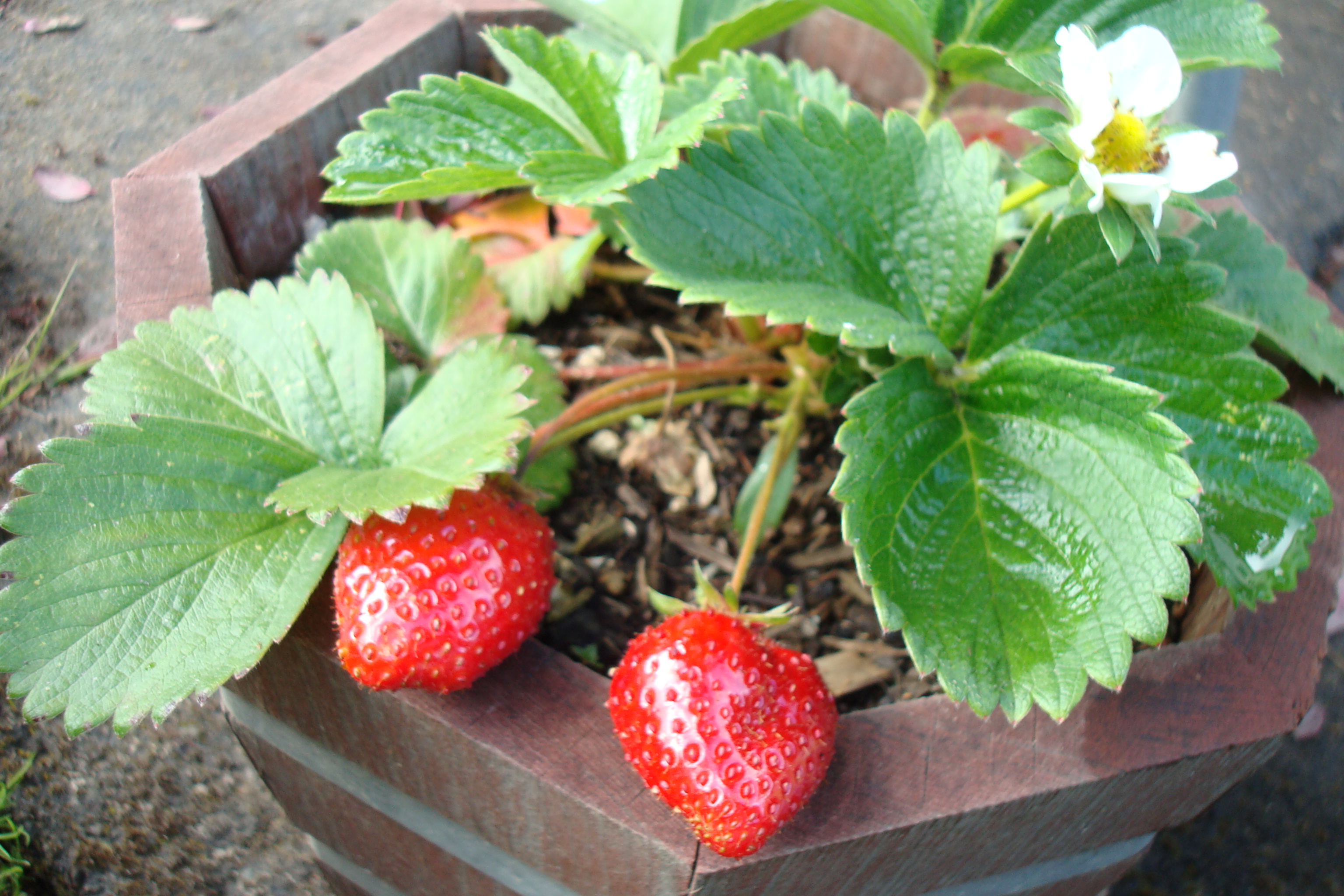
Unfortunately, most of the berries I planted won’t yield much this year. I’ve only managed to sneak a ripe one or two. Most of the blossoms are supposed to be plucked off the first year, to improve future harvests. Most berries plants and fruit trees force delayed gratification on you.
So imagine my delight when I stumbled upon a meadow just studded with these fragrant ruby orbs at Lumos Winery near Philomath on Memorial Day. While wine-tasting, I plodded out there in search of the nearly extinct Fender’s Blue Butterfly that lives among the Kincaid Lupine in a rare open stretch. But I’m ashamed to say that from a distance, the precious butterfly looked more plain and moth-like. But the berries underfoot soon captivated me. It’s hard not to smoosh them as you walk since the wild berries grow so close to the ground. The tiny berries are tart yet sweet, with more concentrated flavor and perfume (even when not fully ripe) than our conventional varieties. You’d have to pick a ton of them, though, to have enough for a recipe. Maybe I could gather enough to make that Italian wild strawberry liqueur.

Wild strawberries underfoot.
I planted some wild ones earlier this year, but now I want more. Why don’t we rip up the grass and cover the lawn with wild strawberries? It would be the perfect union of horticulture and wild-crafting. A fusion of gardening and foraging is my ideal. There’s nothing like stumbling upon something valuable growing freely in the wild.

Strawberries integrated into the landscaping in front of a Corvallis home.
Monica Bhide’s Morel Pulao with Cashews

Morel Pulao with Cashews.
I don’t cook Indian often at home, but it’s not for lack of love of the cuisine, and especially, its fragrant spices. I reviewed Ragavan Iyer’s tome while at The Sun and just met this Indian chef extraordinaire at the recent IACP conference in Portland. But lately I’ve been most fascinated by the fusion recipes of Monica Bhide, who regularly writes for The Post‘s food section and NPR’s Kitchen Window. And her newish Modern Spice cookbook is a gem. Mark Bittman wrote the introduction.
Because morels are the most tempting wild mushroom now in season, Bhide’s Morel Pulao with Cashews grabbed me. I’ve made it twice now, both times without the exact ingredients on hand. I substituted sauteed chanterelle duxelles for the morels the first time and used fresh ones this second time. Didn’t have paneer on hand to use either time, and I had trouble “stuffing” the morels without causing them to crumble. Still, this aromatic, flexible basmati rice dish makes an excellent side or even main dish with a salad. Sauteeing the cardamom, cinnamon stick, bay leaves, grated onion and ground cashews together creates quite a comforting perfume. This is delicate Indian comfort food. The recipe is also less complicated than it sounds. Maybe next I’ll tackle South Indian masala dosas, with their fermented crepe batter. But for now, a rice pulao is a nice place to start. Click below for the recipe.
Beguiled by Berries

What are those, tomatillos? Hopefully they'll be deep indigo and sweet soon.

Just a strawberry or two to tease us.
Of all the bounty that grows in Oregon, our berries are best. We even have certain varietals–think Marionberries–exclusively developed and grown here. So naturally I’d want to try to cultivate some of these sweet gems in my home garden.
Last summer, let’s just say I didn’t get off to the best start. I bought a hanging strawberry basket that unfortunately dried up, as it got ignored while we were traveling all of July and part of August. I also had two discounted blueberry plants shrivel up when I waited to long to plant them. But a $2 gooseberry from the Habitat for Humanity Restore miraculously survived. It’s only promising about two gooseberries this spring, but that’s a start. Not that I’ve ever cooked with gooseberries. But I hear they make nice pie and jam.

A wee gooseberry or two.
To keep slugs at bay, I’ve got about a half dozen strawberry plants in small pots. The ants still seem to be crawling all over the few ripe owns. Our erratic weather just hasn’t been warm enough to redden them up. Heck, it even hailed last week, and farms suffered the damages. I can see why local growers such as Denison Farms do strawberries in hoop houses. Now I appreciate their labor. And they grow them without pesticides or chemical fertilizers, unlike my once-beloved Baugher’s pick-your-own berry farm in Maryland. When I went out to the Taneytown area farm to report my story for The Baltimore Sun, I remember some whitish and blue chemical residue around their strawberries made those bright red rubies slightly less appetizing.

Evidence of Thursday's brief hailstorm.
At least one of two blueberry plants looks like it will yield a bit of a crop. I dug two scrawny five-year old bushes (can’t remember if they were Bluecrops, Chandlers or Dukes) up from a patch Hazelnut Hill orchard wanted to clear out. Not bad for $5 a piece. But I probably didn’t amend our clay soil enough before planting those shallow rooted things at home. I did try to mix in some acidic mulch to encourage the ground to drain a bit better. Then we had a truck blow some mulch into the area. Hope it wasn’t all for naught. It did pain me to see the honeybees mostly ignore my two bushes in favor of the neighbors’ heartier berries in early May. I planted ours near their border, to encourage cross-pollination. Survival of the fittest, indeed.
Luscious Yogurt Panna Cotta: My New Favorite Make-at-Home Dessert
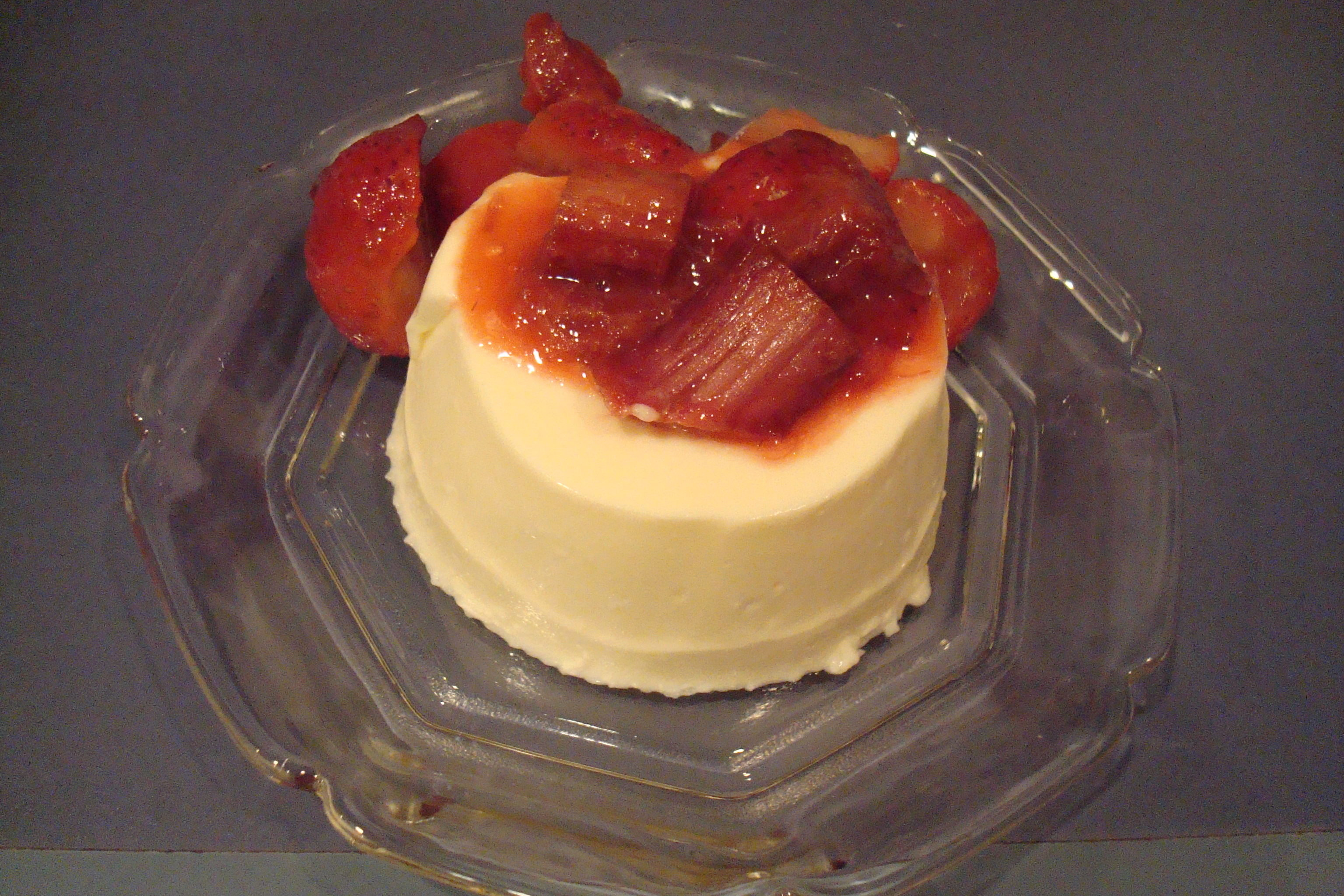
With a stewed strawberry-rhubarb sauce.

Or with creamy, non-stringy Atulfo mango, mint and lemon verbena.
Searching for a fail-safe dessert recipe that’s always sure to impress your guests? What about a simple, but elegant, no-bake panna cotta?
I ran across this luscious recipe from our local Nancy’s Yogurt while searching for something new to do with rhubarb. It’s from Cathy Whims of Portland’s acclaimed Italian spot, Nostrana. To lighten it up, I used two-thirds yogurt to one-thirds cream. I couldn’t stop dipping my spoon into the pot as the concoction warmed. And it was hard to wait overnight for the gelatinous molds to cool before digging in. But then your work is done and your dessert sits patiently in the fridge, waiting for your guests. Minimal assembly is required. Just un-mold the ramekins, jiggling the panna cotta out with that satisfying Jello thwump. Garnish with fruit and serve. In addition to strawberry and rhubarb, it’s also delicious with creamy, cut-up mango.
Your guests will be delighted. My brother-in-law said it was one of the best desserts (he must have meant at-home desserts) he’s ever had. It’s like a custard or creme brulee but easier on the waistline and so much easier to prepare. This yogurt panna cotta almost reminds me of that custard-style Yoplait Thick & Creamy I used to love as a child, but better. It’s all about the texture. But then so many memorable foods are.
I think I’ve only made panna cotta once before, a lumpier pumpkin panna cotta for Thanksgiving that was hard to strain and keep smooth. I remember loving a passion fruit panna cotta I once splurged on at the Silver Moon Bakery on the Upper Upper West Side. I plan to make this panna cotta during next winter’s grapefruit season. This non-baker is thrilled to have another dessert to add to her repertoire. Just don’t wear it out, right?
The Simplicity of Sushi

Tried rice on the outside for the first time.
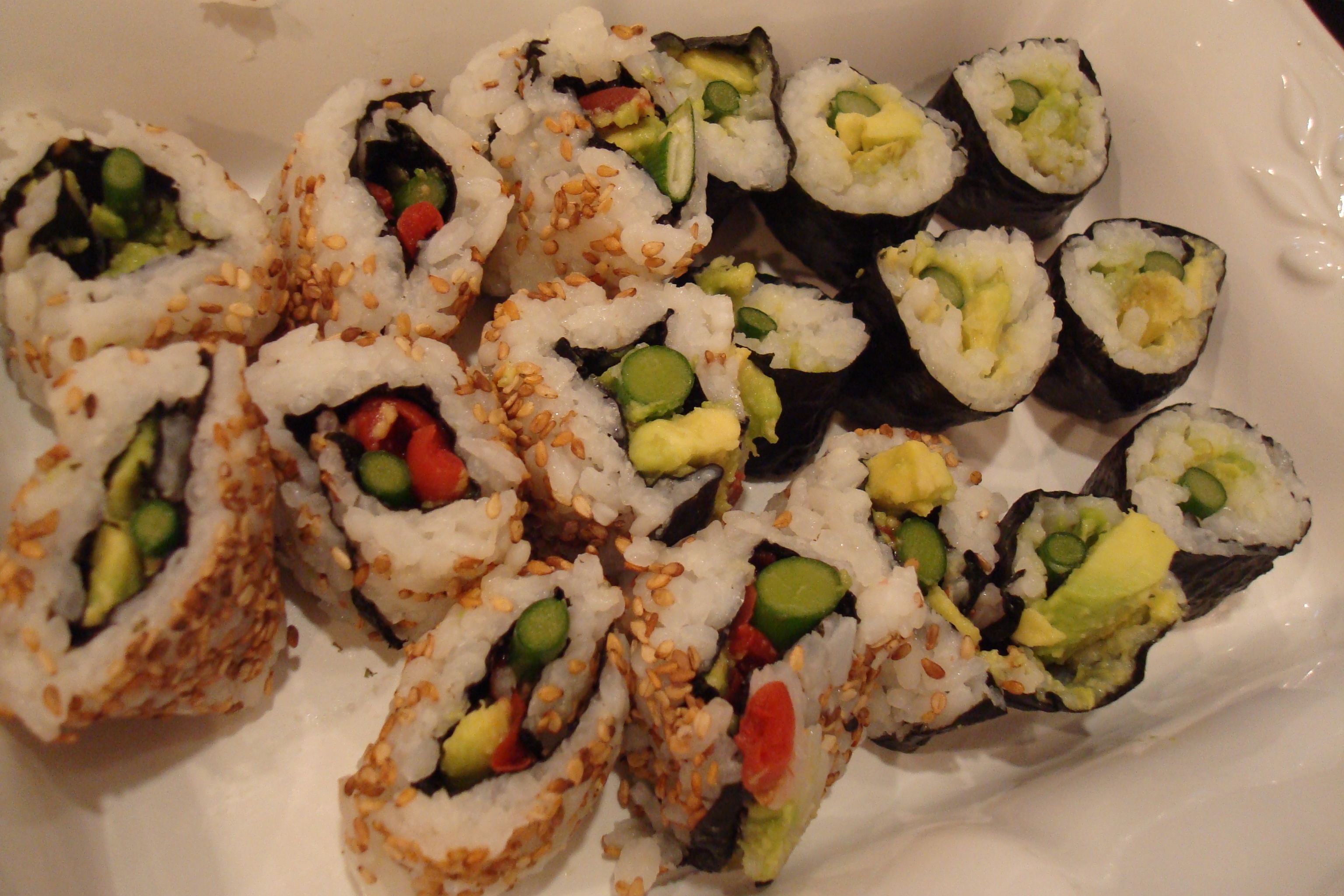
Imperfectly shaped but still delicious homemade maki rolls.
Just when I start getting back my momentum, I’ve abandoned you dear readers (if you still exist!) again. My sister was visiting from ATL, and then this week I had the cheesy Food Show and mounds of end-of-term papers to still grade. Excuses, excuses, I know.
After clogging my arteries with too much free cheese at the recent Seattle Cheese Festival, a light meal of raw, fresh, vegetal sushi appealed. I sprang for some nori, tiny ume plums, roasted sesame seeds and polished rice at Rice & Spice, a little Asian mart near downtown that I’m reminded of when I bike by. We had a ripe (now in season from California!) avocado at home as well as shaved ginger I pickled recently, with Linda Ziedrich’s easy recipe. And I had garlic scapes from dear Sang to use instead of scallions in the rolls. Though now I worry why hasn’t my garlic, which I dutifully sowed around Columbus Day, produced its own scapes yet? I want to make garlic scape pesto!
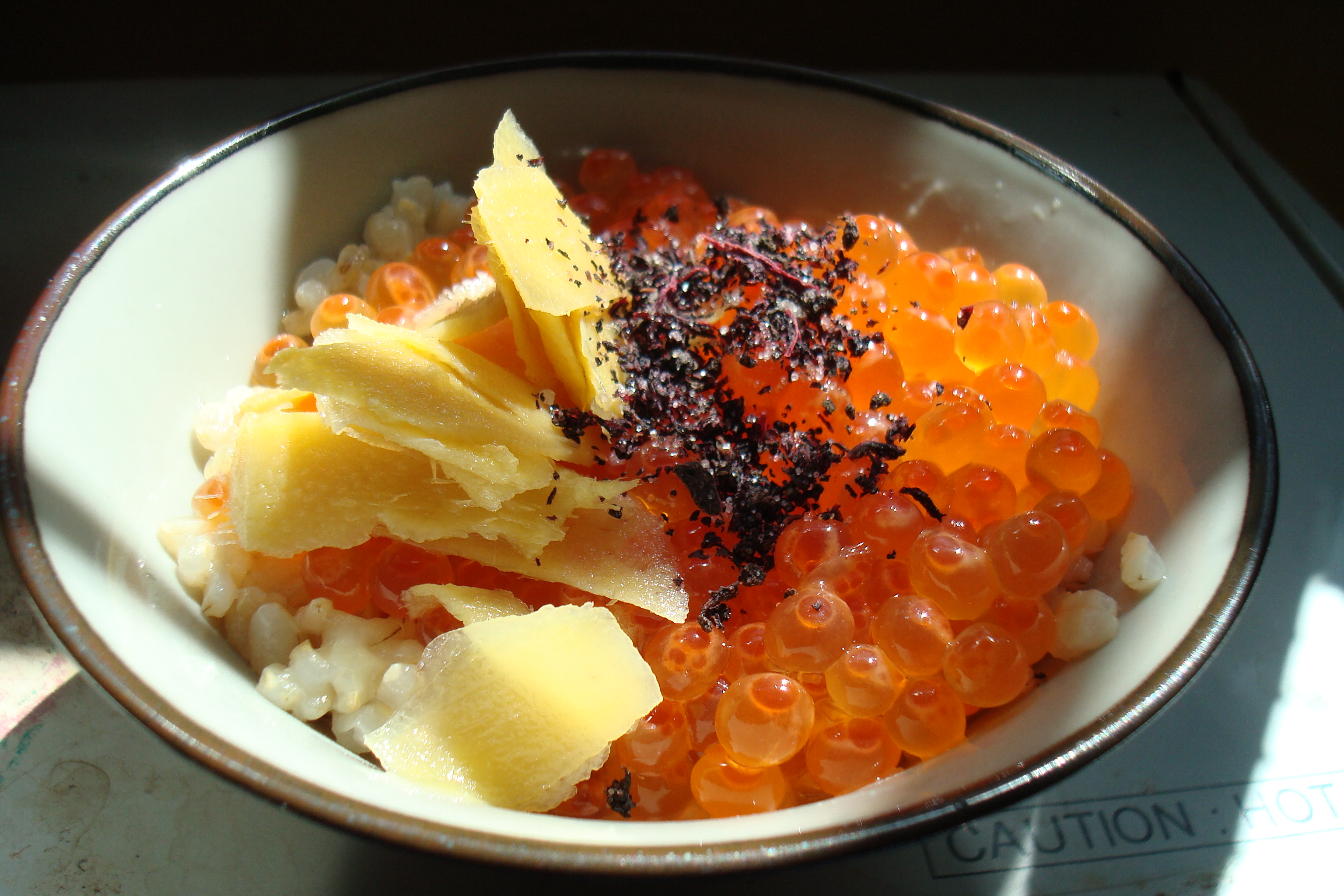
My pickled ginger over too fishy salmon roe. I bought it frozen but it is better (and less smooshed) fresh.
My package of nori prodded me to try an inside-outside fancy maki roll, with rice and roasted sesame on the outside, for the first time. If you line your bamboo mat with plastic wrap it really isn’t any harder than a regular roll. Just really press the rice into the sheet of nori. And cut that sheet in half. I usually use the whole sheet but that makes it actually harder to roll. Cutting is always harder than rolling for me. That’s when the sushi can fall apart. It’s important to cut the rolls with a sharp knife, which sadly mine are not. Nothing like making sushi to remind a gal her knives need sharpening!
Warming Up to Rabbit

New Zealand-California crosses on Julia Sunkler's farm.
Check out my FOODday article this week on Oregon’s rabbit farmers. It certainly generated a lot of criticism. But active debate as good, as long as folks remain respectful. I hope my critics will note that non-profits such as Heiffer International encourage subsistence farmers to raise rabbits for meat to prevent hunger and reduce global poverty.
 BaltimOregon to Maine