Third KBOO Radio Show: Local Foods Special
 I’m just loving my adventures in Radio-land. I’m still in awe that such distinguished food folks have agreed to come on the show. Today I had the pleasure of interviewing Portland-based chef and food writer Ivy Manning, whose Farm to Table cookbook is one of my new favorites. Click here to listen to the archived show.
Our local foods special also featured an interview with the Portland Farmers Market director on expanding access through the new Sunday King neighborhood market. We also talked to local chain Burgerville about their campaign to highlight local (but not organic) foods on their menu. After the show, I got a chance to taste firsthand the Yakima, Wash.,-grown asparagus Burgerville is promoting this month. It was delicately fried, tempera-style, and served with a garlic mayonnaise dipping sauce. But the Burgerville promotion also includes an asparagus and tomato melt sandwich on the menu. Doesn’t that less than local tomato cancel the asparagus out? The Burgerville COO said their tomatoes are from California but could some be produced under sub-slavery conditions in Immokalee, Fla.? Could enough Burgerville customers say no to out-of-season tomatoes to make the company change their policies?
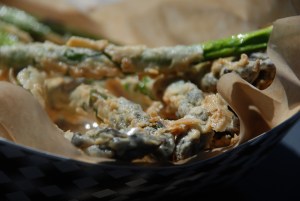
Burgerville Fried Asparagus/Flickr Creative Commons/By kthread
Herb Flower Vinegar

We'll see how this infusion tastes in a month.
Hat tip to Culinaria Eugenius for reminding me to make my own herb flower vinegar before it’s too late. I immersed trimmings from flowering rosemary, thyme, chives and sage plants, plus some dill and lemon peel, in a white wine vinegar bath. Make sure to use a jar with a non-reactive, non-metal cap. The vinegar sits at least a month in a cool, dark place and then it’s ready to use.
I’ll be learning more techniques on flavoring vinegars and oils in my Master Food Preservation class later this month.
I’d really like to make a pure French-style tarragon vinegar, but the tarragon start I planted is rather puny. Mom used use it in a (Silver Palate, I think) tarragon chicken salad she often made. Any suggestions on how to promote more vibrant growth? What keeps tarragon happy?

My slow-to-grow tarragon plant.
Lamb Meatballs Redux

We had ground lamb in the freezer from Bald Hill Farm just down the road. So I recreated the sesame-crusted meatballs we feasted on last week. Take a pound of ground lamb, chop lots of mint, parsley, dried figs and green garlic, beat in an egg and grate in orange zest. Serve with a minted yogurt sauce. Here’s a version of the recipe from Gourmet Magazine here. They were aromatic, crunchy yet moist on the inside. But Dan still prefers his lambs in stews or more saucy, curry-like creations.
Digging Clams: From Sandy Spade to Chowder Bowl
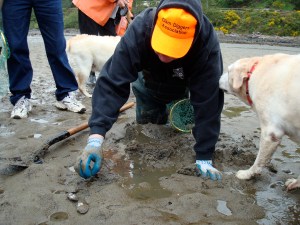
Bill Lackner, leading a clam clinic on Siletz Bay in Lincoln City Wednesday.

Our bountiful harvest of purple varnish and Eastern softshell (think Maine steamers) clams.
I am officially obsessed with foraging for food. And there are boundless opportunities to do it here. So when invited to try my hand at digging for clams on the nearby Oregon coast, of course I leapt at the opportunity. We went out at low tide Wednesday morning on the Siletz Bay just down the road from Mo’s Restaurant (famous for their chowder). Bill Lackner, who founded a local Clam-Diggers Association, was our generous guide. He offers free clinics up and down the coast to promote recreational clamming and ensure that the shellfish are harvested sustainably so all can enjoy them. He quickly demonstrated the technique and then we were off!

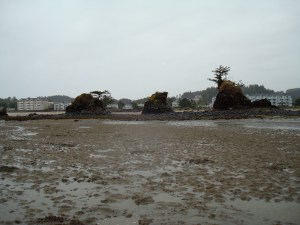
Let’s just say clam-digging is immensely easier than foraging for wild mushrooms. If you don’t mind coating yourself with cold, wet sand. You just use a spade or a clam gun to dig about a foot down and then feel your hand all around the perimeter of the whole. Almost every time I found a clam. Instant gratification. Of course, with the cold water, our fingers got numb, making it difficult to feel out the shells as the digging progressed. I also kept cracking the shells with the shovel or gun. It takes finesse not to do so.
Our Oregon Department of Fish and Wildlife shellfish license entitled us to each collect 36 clams per day. Let’s just say you shouldn’t have a problem meeting that target.
We found mostly hearty purple varnish clams (native to Japan, planted on the Oregon coast in the 1990s) and a few large Eastern softshell, I believe the same species as our beloved, chewy necked steamer clams in Maine. And when life gives you clams, you make chowder. Spicy tomato Manhattan-style is my chowder of choice, which I fondly remember my Bronx-born Nonny would make. The applewood-smoked bacon and the Spanish chorizo I added to the broth really gave this chowder bite. I first made this recipe (see more details below), from Arthur Schwartz’s New York City Food, for a review I penned for The Sun. I also threw in caraway seeds to make it like they did on Coney Island.

-
The chowder
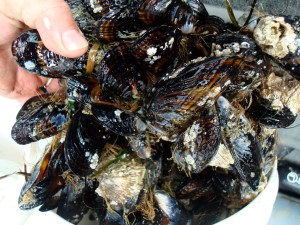
- Barnacled-encrusted beardy mussels we also found
Manhattan Clam Chowder
- Yield: Serves about 8
No one really knows who made the first clam chowder with tomatoes, the chowder known as Manhattan. New Englanders, mainly those from Massachusetts and Maine, whose chowder is enriched with cream (or evaporated milk in more modern recipes), laugh at the folly of a tomato-flavored chowder. Neighboring Connecticut and Rhode Island, however, states with New England coast credentials as valid as Cape Cod, make chowder without either cream or tomatoes. The traditional Rhode Island chowder is a gray clam broth with nothing more than salt pork, potato, and, interestingly, thyme as the seasoning, the same as New York City’s. Indeed, some Rhode Island chowderheads speculate that Manhattan chowder is really a variant of Rhode Island chowder, the chopped tomatoes a contribution of Rhode Island’s large Italian-American community, most of whom hail from the tomato-rich Italian south. But, there are other theories, too.
Whatever the origin, clam chowder made with tomatoes and thyme was popular in the Coney Island, Brighton Beach, and Manhattan Beach hotel restaurants of the 1880s to the turn of the century. When Coney Island became the beach resort of the people streaming off the new subway lines in 1921, Manhattan Clam Chowder really took off. (I have also read a few references to caraway being the seasoning in Coney Island Chowder.)
My grandfather, Bernard (Barney) Schwartz was a professional Manhattan Clam Chowder chef. During the Depression, after he had lost his restaurant business, he sold chowder, along with some other bar foods of the day, off a pushcart to bars and grills. I watched him make chowder many times, along with his other specialties—pickles, coleslaw, and potato salad. He always insisted on using really big chowder clams, never Littlenecks or Cherrystones, which he put through the meat grinder. I have tried making chowder with the smaller clams, but Barney was right. The result tastes more like vegetable soup than clam chowder. You need the strong flavor of big clams to make this work.
Ingredients
- 2 dozen large chowder clams, well-washed
- 4 ounces bacon or salt pork, cut into ½-inch pieces
- 2 tablespoons vegetable oil
- 2 medium onions, cut into ¼-inch dice
- 1 medium carrot, cut into ¼-inch dice
- 1 large rib celery, cut into ¼-inch dice
- 1 large green pepper, cut into ¼-inch dice
- 1½ pounds potatoes, cut into ½-inch cubes (about 3 cups)
- 1 (28-ounce) can peeled plum tomatoes, with their juice, the tomatoes coarsely chopped
- 1 teaspoon dried thyme
- 1 large bay leaf
- Freshly ground black pepper
- Salt to taste
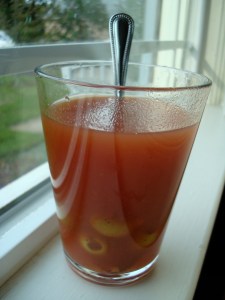
Make a Clamato cocktail with the leftover clam juice!
Directions
In a 5-quart pot, combine the clams and 6 cups of cold water. Cover and place over high heat. When the water begins to boil, uncover the pot and boil the clams until they open, 2 to 3 minutes.
Remove the clams from their shells. Set aside in a large bowl.
Strain the broth through a sieve lined with a few layers of cheesecloth or a tightly woven cloth napkin. Leave behind any sand that may have settled in the pot. You should have slightly less than 8 cups of liquid. Set aside.
Rinse out the 5-quart pot and dry it.
Put the bacon or salt pork in the pot and cook over medium-low heat until some of the fat has rendered and the meat has lost its raw color.
Add the diced onion, carrot, celery, and green pepper. Toss well, then cook over medium heat until the vegetables are well wilted, 10 to 12 minutes.
Add the potatoes and the reserved and strained clam broth. Bring to a boil, then adjust heat so broth just simmers. Cook until the potatoes are tender, about 15 minutes.
Add the chopped tomatoes, the thyme, and the bay leaf. Continue to simmer another 30 minutes or so, until the vegetables are very tender.
Meanwhile, push the clams through the medium blade of a meat grinder, or finely chop them in a food processor.
When the chowder has cooked for half an hour, add the clams, then shut off the heat.
Add freshly ground pepper to taste. Correct the salt—the chowder may not need any because clams are salty, and the tomatoes have salt, but usually it does.
The chowder is much better when it is allowed to stand for several hours, or refrigerated overnight, then gently reheated just to the simmering point.
Cougars in Corvallis

Cougar/Flickr Creative Commons/By ucumari
Yikes! A ferocious cougar was spotted mauling a house cat right here in Corvallis last month. Once hunted to extinction, it seems record numbers of the giant cats live in Oregon these days. Now a young college student has mobilized to save the spotted cougar’s life here. If one crosses my path, I just hope it’s at a safe distance.
It’s pretty surreal to be living in proximity to such a feral beast, which mostly seemed a mythical creature as our school mascot. The closest we got to seeing a real cougar growing up was the stuffed, glass-encased one in the gym.
Lamb Meatballs, Part Deux
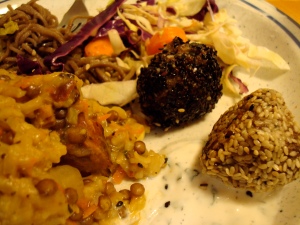
Lamb meatballs, jambalaya and portabello mushrooms/soba noodle sautee
Wondering what to do with that ball of ground lamb in your freezer? I had almost forgotten about sweet, Morrocan-inspired lamb meatballs. At a potluck tonight, our host served white and black sesame seed-coated ones with chopped figs, nutmeg and fresh mint in the mix, served with a yogurt sauce. They were more subtle than the citrusy prune ones I made last fall. You always learn new kitchen tricks at a shared meal.
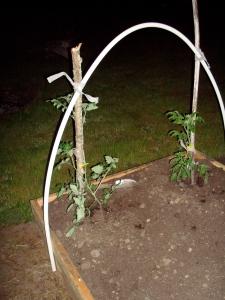
The home in Southtown Corvallis also has a chicken coop and numerous well-crafted raised beds of vegetables. They’ve staked their early-planted tomatoes with plastic hoops so they can cover the vulnerable nightshades to keep them warm on these still chilly nights. I’ve just been leaving my tomato starts out on the deck. Hopefully they survive.
United By Our Love of Rhubarb, Edible Gardens, Food Preservation and Backyard Coops
Though of course I already felt like I knew them. Amy and Matt kindly had us over to their renovated Eugene home. There, we indulged on grilled baby back ribs (marinated with homemade smokey peach and Hoisin sauces), cornbread, bay shrimp-topped deviled eggs, kale bruschetta, grilled chicken with cilantro jalapeno pesto and a baby potato salad. It was a feast. Amy and Matt were the consummate hosts, ensuring that our glasses never went empty. We drank ginger-cilantro lemon-drop cocktails, crisp and addicting rhubarb sodas and lots of local beer.I had such a good time, I forget to photograph the spread of food! I also made a potchka for dessert: a custardy “Coconut-Cardamom Rice Pudding with Rhubarb” (minus the kumquats). It was a yummy, South Asian-inflected, sweet/tart concoction but probably not worth the effort.
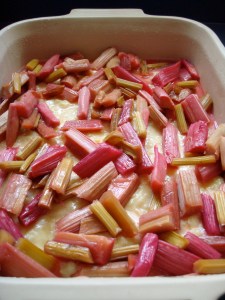
rhubarb rice pudding

Chickens in the backyard of Our Home Works
Food Preservation: Freezer Time

Frozen rhubarb...who knew?/Flickr Creative Commons/By jesshibb
My mom canned tomatoes and grew her own sprouts when I was an infant. Then she stopped. Before I got to learn how. But now is my chance to lay claim to those lost food preservation arts, which are enjoying a revival in this recession, embraced by do-it-yourselfers already enchanted with knitting and gardening. So I enrolled in the master food preserver course offered by the local Oregon State University Extension Office. For $40, we spend our Thursdays for eight weeks delving into hot water and pressure canning, jellies and jams, freezing, pickling, dehydrating and all the related food safety issues (goal number one: avoid death by botulism).
Our first class today we focused on freezing techniques, which just happened to coincide with Mark Bittman’s “Freeze That Thought” piece this week. It’s a great freezing 101 primer. Who knew you needed a freezer thermometer, to ensure you are set at 0 degrees. A higher temp reduces storage time.
Freezing is the gateway to more difficult preservation methods. No additional equipment is required. (Although Oregonians are gaga for those huge chest garage freezers, which they fill with that cow share they buy into.) But as Bittman says:
IF I tried to sell you a new appliance that could help you save money, reduce food waste and get meals on the table faster, the only thing you’d ask would be “How much?”
The answer is “Nothing.” You already own it. For just as the stove comes with a hidden and often overlooked bonus — the broiler — so does the refrigerator: the freezer. Why not use it?
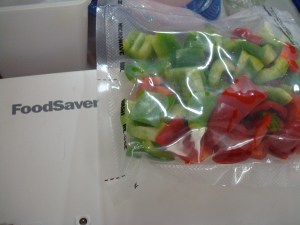
I’ll begin by freezing slices of rhubarb this weekend. I crave the tart fruit in crisps all winter. Now I can have it. It just takes a little planning ahead. No need to buy the fancy Food Saver vaccuum sealer our teacher demoed in class. Are they really worth it? You can use the vacuum to seal lids on Ball jars. I’ll stick to the hot water bath. Now if only my mother hadn’t given away her canning equipment:(

Feliz Cinco de Mayo!

Corvallis Mexican folklore 4-H club kids doing a dance from Veracruz
We had to grab a quick dinner tonight. So why not head to La Rockita, the local chain of affordable, authentic Oaxacan-style Mexican restaurants, especially since it was Cinco de Mayo? I’m always craving their tacos de lengua (braised beef tongue).
Little did we know we were in for a special treat. Traditional Veracruz and Jalisco Mexican folklore dances by colorfully costumed kids from a local 4-H club. It was pretty precious. But I should have stuck with the tongue tacos. The camarones de crema was too fishy and rich. Consistency. Keep it simple. I’ve found a simple dish that can’t be improved upon. Succulent meat, its grease undercut by crisp radishes, diced onions, cilantro and a squeeze of lime. Enfolded in a warm corn tortilla shell. Why should I order anything else?

Le le le lengua
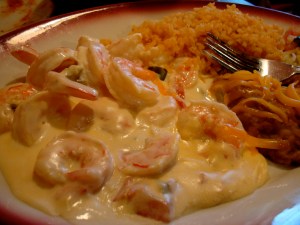
Skip the camarones de crema
No More Waiting for Asparagus
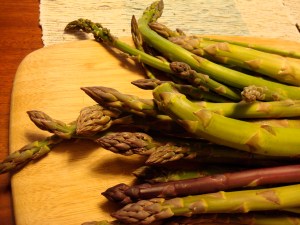
Oregon asparagus

Baltimore (well actually Seaford, Del.) asparagus
You’ve heard about the rhubarb. Well, asparagus is that other early spring vegetable for which I eagerly await. Its presence marks the start of this abundant season. Maybe I’ll eventually plant my own asparagus bed, like Barbara Kingsolver, but you have to wait three years for the harvest. For now, procuring the green (and sometimes eggplant purple) spears from local farmers will more than do.
Asparagus featured prominently at my beloved old Waverly Farmers Market in Baltimore, which I got to visit when briefly in town for a wedding last weekend. That’s Hannah and I fingering the skinny, almost stringy stalks for sale at the stand run by a farmer from Seaford, Del. But Hannah said they’ve been tough and not that flavorful. Here in Oregon, the spears are mostly sweet and fat. I received deliveries of them from the local organic Sunbow Farm here in Corvallis. Just order $10 of produce and they’ll deliver to your door. Pretty nice when you don’t have a CSA but are out of town for the weekend farmers market.
What do you make with your April and May fresh asparagus? I recommend this “Sesame Noodles with Fresh Asparagus Tips” recipe from Deborah Madison, via Culinate. I added local sauteed shittake mushrooms to the mix. Also substituted flat rice noodles for the Chinese egg ones, but don’t recommend that. And tonight I topped pasta with fresh local fava beans and asparagus, sauteed with leeks and green garlic in olive oil and a chicken broth and lemon juice sauce. Topped with chopped parsley, dill, tarragon and chives from the garden, it made for a light springy meal.

Sesame Noodles with Asparagus

Tonight's lemony asparagus pasta
 BaltimOregon to Maine